Open-cell vs. closed-cell spray foam: Which is right for your Michigan home?

We've installed spray foam in thousands of Michigan homes, and the open-cell vs. closed-cell question is one of the most common we hear. The answer isn't complicated once you understand what each type actually does and what your home needs it to do. If you want to skip straight to a recommendation for your project, we're happy to take a look.
Ecotelligent Homes is one of the only SPFA-certified residential spray foam contractors in Michigan.
Table of contents
Open-cell vs. closed-cell: quick comparison
| Open-Cell Spray Foam | Closed-Cell Spray Foam | |
|---|---|---|
| R-value per inch | R-3.5 to R-3.8 | R-6.0 to R-7.0 |
| Vapor permeability | Permeable (Class III vapor retarder) | Resistant (Class II vapor retarder at 2+ inches) |
| Moisture vs. water | Resists vapor transmission only | Resists both vapor transmission and liquid water intrusion |
| Air barrier | Depends on thickness | Yes |
| Waterproof | No | Yes |
| Structural rigidity | Soft, flexible | Rigid, hard |
| Typical cost | Lower | Higher |
| Best for (Michigan) | Sound dampening, interior wall cavities where vapor control isn't required | Rim joists, crawlspaces, basement walls, exterior-adjacent areas, tight spaces where high R-value per inch matters, attic roof decks and knee walls |
Both types are spray-applied, and both outperform traditional insulation materials for many applications. The choice between them comes down to where the foam is going and what you need it to do there.
What is open-cell spray foam?
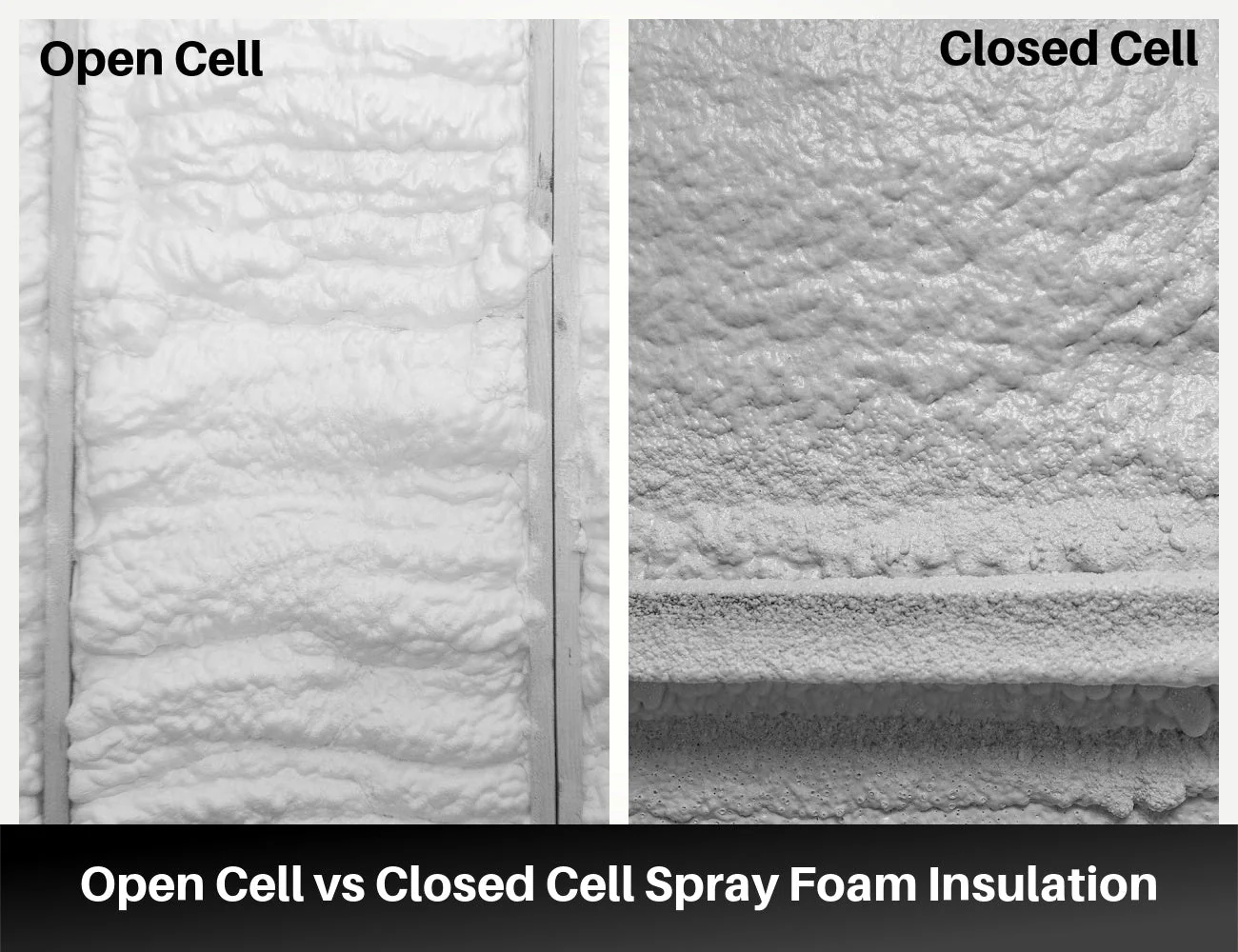
Open-cell spray foam is a lightweight, soft insulation material. The cells in the foam are not fully enclosed, which is what makes it permeable to water vapor. It expands significantly on application, sometimes up to 100 times its liquid volume, making it easy to fill irregular cavities.
R-value and thickness: Open-cell delivers around R-3.5 to R-3.8 per inch, which means reaching R-20 in a wall cavity requires roughly 5 to 6 inches.
Where open-cell makes sense:
- Interior wall cavities where the wall assembly is designed to dry to the inside and vapor control isn't required at that surface
- Sound control between interior spaces (open-cell has better acoustic properties than closed-cell)
- Applications where budget is the primary driver, vapor management is handled elsewhere in the assembly, and the location is interior
Where open-cell is the wrong choice in Michigan:
Any exterior-adjacent application in a CZ5/CZ6 climate - rim joists, crawlspace walls, exterior basement walls - should not use open-cell. Michigan winters create inward vapor drive that open-cell can't adequately resist. More on this in the Michigan-specific section below.
Open-cell also has no resistance to liquid water. It will absorb water if it contacts a wet surface, which is another reason it doesn't belong anywhere near ground level or exterior exposure.
What is closed-cell spray foam?
Closed-cell spray foam has a rigid, compact cell structure where the cells are fully enclosed. That's what gives it a dramatically higher R-value per inch, structural rigidity, and vapor resistance that open-cell can't match.
R-value and thickness: Closed-cell delivers R-6.0 to R-7.0 per inch. At 2 inches, it also functions as a Class II vapor retarder, which is a meaningful performance threshold in Michigan's climate zones.
That vapor retarder function addresses moisture in the air moving through the assembly. Closed-cell also resists liquid water intrusion directly, which is a separate property and why it's the right choice anywhere water contact is possible, like rim joists, crawlspace walls, and below-grade surfaces.
Where closed-cell is the right choice:
- Attic slopes and knee walls in conditioned attics. Closed-cell on the roof deck underside keeps the attic within the thermal boundary of the home and lets you use the attic floor for storage.
- Rim joists. One of the highest-impact uses. Closed-cell air seals and insulates in a single application, at a thickness that fits in a tight joist bay. Its waterproof characteristics also make it a great choice for areas at or below ground level.
- Crawlspace walls. Spray foam on the walls brings the crawlspace into the conditioned space and handles both vapor and air control in one step. It's also waterproof, so it helps keep a dry crawlspace dry.
- Basement walls, especially where moisture intrusion is a concern or wall assembly depth is limited. A great fit for Michigan basements.
- Tight spaces where R-value per inch matters. A few common examples: low-pitch roofs where there isn't much vertical space between the attic floor and the roof deck (closed-cell paired with premium baffles is a great solution there - see our guide to attic baffles), or 2x4 exterior wall cavities. Open-cell typically needs 2x6 framing to hit code, but with closed-cell you can meet or exceed code in a standard 2x4 cavity.
- Any exterior-adjacent surface in Michigan where vapor control is required.
At Ecotelligent Homes, closed-cell is our recommendation for most Michigan applications. It's not the cheapest option, but it does more per inch than anything else available. And in a state surrounded by Great Lakes with thousands of inland lakes nearby, moisture control isn't a nice-to-have - it's a real, year-round issue. Closed-cell's built-in vapor barrier and waterproof qualities are a big part of why we keep coming back to it.

"The question I get most often is: 'My contractor said open-cell is fine, is that true?' Sometimes it is. But a lot of contractors default to open-cell because it's less expensive and faster to apply. In Michigan, for rim joists and crawlspaces, that's the wrong call. Closed-cell handles moisture control that open-cell just doesn't and in Michigan moisture control matters."
– Amanda Godward, Owner, Ecotelligent Homes
What is injection foam? (And how is it different?)
Injection foam is a different product than spray foam. It's designed to fill existing enclosed wall cavities through small holes drilled into the siding or drywall, using a slow-expanding formula that won't blow out the wall. It's often marketed as the easy no-demo retrofit solution for adding wall insulation to finished homes.
Why we don't use it and what we recommend instead
At Ecotelligent Homes, we don't install injection foam. Our recommendation for retrofitting existing wall cavities is dense-pack cellulose, and the reasons come down to a few consistent problems we've seen with injection foam:
- Shrinkage. If the product isn't mixed correctly during installation, it shrinks over time. That creates cold pockets in the wall and condensation issues that show up later.
- Inconsistent coverage. Injection foam doesn't always fill completely around wiring, pipes, and blocking. Dense-pack cellulose is blown in under pressure, which means it fills the cavity more completely.
- Drywall damage. Improper installation can cause drywall to crack or bow, especially in walls that have been repaired or reinforced before.
- Lower R-value. Injection foam comes in around R-4.6 per inch. Dense-pack cellulose hits R-13 to R-15 in a standard 2x4 wall cavity.
Dense-pack cellulose goes in through small holes drilled under the interior trim or through the drywall, which are patched afterward. It's not significantly more disruptive than injection foam, and the long-term performance is much more reliable. It's also made from recycled paper and produced locally here in Michigan.
If wall insulation is your goal, we'll assess your wall assembly during a home energy audit and walk you through what makes sense for your specific home.
Got a project in mind?
Tell us about your project, and we'll send ballpark pricing in 2 minutes or less.
Michigan homes and vapor control: why it matters
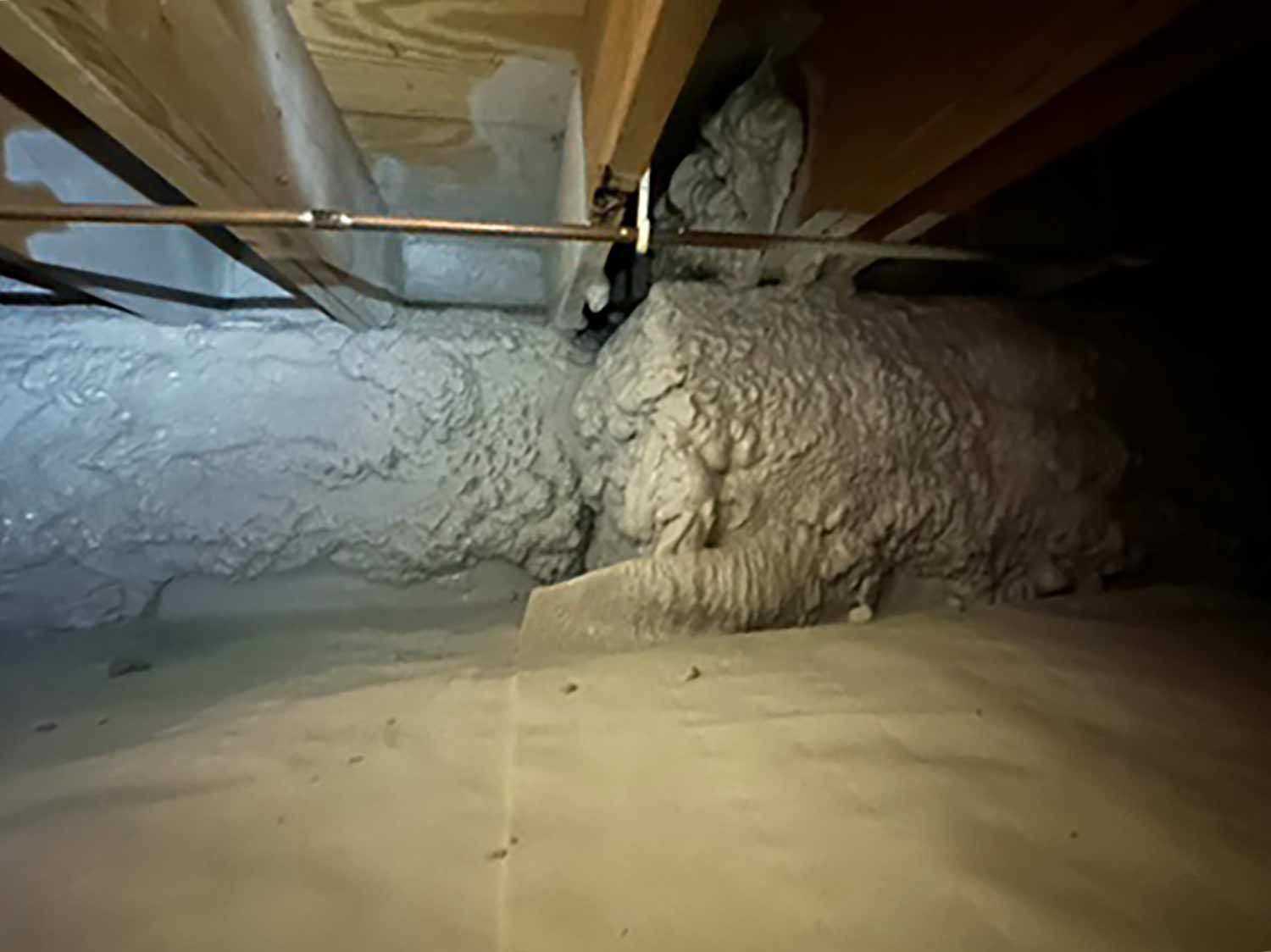
Michigan sits in Climate Zones 5 and 6. In practical terms, that means cold winters with significant heating demand, and a vapor dynamic that favors insulation materials with vapor resistance in exterior-adjacent applications.
Here's the underlying issue
In winter, warm air inside the house tries to push outward, carrying moisture with it. When that vapor-laden air hits a cold surface, like the exterior sheathing on a rim joist or a crawlspace wall, it can condense. Over time, that condensation causes mold, rot, and insulation performance degradation.
A Class II vapor retarder (like 2+ inches of closed-cell spray foam) slows that vapor movement to acceptable levels. Open-cell spray foam, which is vapor-permeable, doesn't.
Michigan building code and vapor retarder requirements
Michigan follows the International Residential Code climate zone classifications. CZ5 requires a Class II vapor retarder on the warm-in-winter side of insulation in wall assemblies. Closed-cell spray foam at 2 inches satisfies this requirement. Open-cell does not.
This is why the material choice isn't just a preference question. It has real code and performance implications for how your home handles Michigan winters.
Where this plays out most often in EH projects
- Rim joists: almost always closed-cell. They're at the exterior envelope, they're cold, and open-cell at a rim joist creates a vapor management problem.
- Crawlspace walls: closed-cell, typically 2 inches minimum. Vapor control at the crawlspace wall is critical in Michigan.
- Attic decks (insulating the roof deck underside in a conditioned attic): the wall assembly analysis here is more nuanced, and the right answer depends on the roof assembly. This is something we evaluate during an audit.
- Standard wall cavities in an addition or new wall: situation-dependent. Open-cell may be appropriate depending on the full wall assembly design.

Cost comparison: what you're actually paying for
Closed-cell spray foam costs more than open-cell. That's consistently true. But the cost-per-R-value picture is more nuanced than the per-board-foot price suggests.
Cost factors to understand
Thickness required: To reach R-20 with open-cell, you need roughly 5-6 inches. To reach the same R-20 with closed-cell, you need about 3 inches. In a tight space like a rim joist cavity, you may not have 5-6 inches to work with. Closed-cell is your only path to a meaningful R-value in that space.
What else you're getting: At 2 inches, closed-cell handles vapor control and air sealing in a single application. Open-cell handles air sealing but not vapor control. If vapor control is required (rim joists, crawlspaces), you'd need to address it separately with open-cell, adding cost and complexity.
Longevity: Closed-cell is significantly more rigid and resistant to moisture absorption. In high-humidity environments like crawlspaces, that durability difference matters over time.
For many Michigan applications, closed-cell costs more upfront and delivers more value long-term. Not because it has a higher R-value per inch (though it does), but because it handles multiple performance requirements in one product.
For a project-specific estimate, use our pricing tool or schedule an assessment. We'll show you exactly what we'd recommend and why.
Depending on the scope of your project, you may also be eligible for rebates through DTE Energy or Consumers Energy that offset part of the cost. We handle the paperwork.
FAQ
Is closed-cell spray foam always better than open-cell?
Not always, but for most Michigan applications it is. Closed-cell is the right choice for any exterior-adjacent area, including rim joists, crawlspace walls, and basement walls, because of its vapor resistance and higher R-value per inch.
Open-cell can be appropriate for interior attic applications, certain interior wall assemblies, and situations where the primary goal is air sealing without vapor control requirements. The best answer depends on where the foam is going and how your wall or floor assembly is designed to manage moisture..
What type of spray foam is used on attic slopes in Michigan?
Closed-cell. When insulating the underside of a roof deck in a conditioned attic, closed-cell spray foam is the right choice. It provides a high R-value per inch in a tight space, acts as a vapor retarder, and brings the attic into the thermal boundary of the home. One practical benefit: once the attic slope is insulated this way, the attic floor is free for storage. See our attic insulation guide for more on conditioned vs. vented attic assemblies.
Can open-cell spray foam cause moisture problems in Michigan?
Yes, if it's used in the wrong location. Open-cell is vapor-permeable, which means moisture from inside your home can move through it in winter. In exterior-adjacent applications, including rim joists and crawlspace walls, that vapor movement can lead to condensation and moisture problems in the wall or floor framing over time. In Michigan's cold climate, closed-cell is the standard recommendation for those locations specifically because it acts as a vapor retarder.
What is the R-value of closed-cell spray foam?
Closed-cell spray foam delivers R-6.0 to R-7.0 per inch, depending on the specific product. At 2 inches, you have roughly R-12 to R-14, plus vapor retarder performance. At 3 inches, you're in the R-18 to R-21 range. For rim joists, 2 to 3 inches of closed-cell is the standard application. For attics, closed-cell is rarely used because the cost per R-value at the required depths (R-49 to R-60) makes blown cellulose or fiberglass far more practical.
What is injection foam, and is it the same as spray foam?
No. Injection foam is a slow-expanding foam designed to fill enclosed wall cavities through small holes. It's used as a retrofit option for adding insulation to finished walls without removing the drywall or siding. Spray foam is applied as an open, expanding application to surfaces. Different products, different applications. At Ecotelligent Homes, we work with spray foam (open and closed cell) rather than injection foam.
Which spray foam is better for a crawlspace in Michigan?
Closed-cell spray foam on the crawlspace walls is the standard recommendation for Michigan homes. It provides air sealing, insulation, and vapor control in a single application, bringing the crawlspace into the conditioned space of the home. Open-cell is not recommended for crawlspace walls because it doesn't provide adequate vapor resistance in Michigan's climate. We also typically recommend a vapor barrier on the crawlspace floor as part of a full crawlspace improvement package.
Which spray foam is right for rim joists?
Closed-cell, almost always. Rim joists are at the exterior envelope of the home, exposed to cold in winter and sometimes moisture from below. Closed-cell spray foam is the right product because it handles air sealing, insulation, and vapor control in a single application, and it achieves meaningful R-values within the tight depth of a joist bay. Most rim joist applications use 2 to 3 inches of closed-cell. See our rim joist insulation guide for more detail.

Ecotelligent Homes
Since 2009, Ecotelligent Homes has completed more than 3,000 projects in Michigan. If you need help with new insulation, efficient HVAC, or abatement services, give us a call anytime: (248) 291-7815. Satisfaction guaranteed.
Got a project in mind?
Tell us about your project, and we'll send ballpark pricing in 2 minutes or less.